Wine, Beer, or Spirits: Which Builds Your Palate Fastest?
Each one trains a different skill. Here is what to drink first if you want to actually learn flavor, and the order that trips most beginners up.
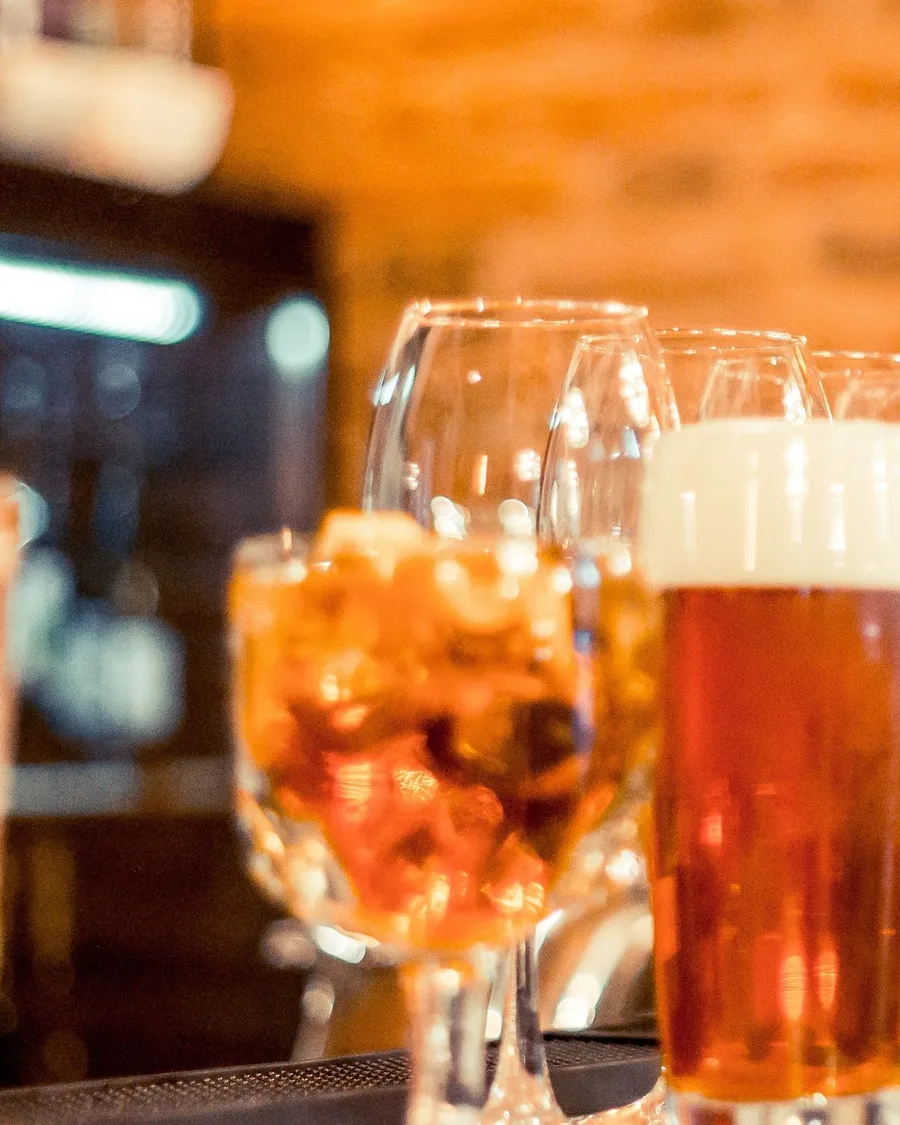
For most beginners, beer builds a palate fastest. Its low alcohol lets you taste more before fatigue and your limit cut you off, its styles span a huge aroma range, and small pours are cheap to compare. Wine is the best teacher of structure, and spirits sharpen concentration, but beer gives you the most attentive reps per session, and reps are what train a palate.
Drinqly is a free download for iPhone.
Get Drinqly on the App StoreAsk a sommelier and a brewer which drink builds your palate fastest and you'll start a friendly war. Everyone's got an answer, and it's almost always the drink they already love, which is a little bit of a giveaway. The honest version is less exciting than either side wants it to be: the category that builds your palate fastest is whichever one you'll actually keep paying attention to, glass after glass. That makes "wine, beer, or spirits" close to a trick question. The three still teach you different things, and the order you meet them in changes how fast it clicks. So here's a fair walk through all three: what each one is good at, where beginners stall, and where to actually start.
A palate is built from paying attention
Start from how the skill is actually learned. Tasting well is pattern recognition. Your nose meets a smell, you put a word on it, and the next time it shows up you catch it a little faster. What builds a palate is how many times you can pay attention, name something, and make it stick. Price and rarity have no say in that. Attention is the whole game.
Hold that lens up to the three categories and a better question appears: which one lets you run the most honest reps before your senses give out? That's what the rest of this walks through.
Beer: the widest range, the cheapest reps
Beer is the most underrated palate-trainer in the room, and it's underrated precisely because it's everywhere. Look past the familiarity and the range is enormous: a hazy IPA reads of grapefruit and pine, a stout of coffee and dark chocolate, a saison of pepper and barnyard funk, a lager of fresh bread and almost nothing else. That spread exists because beer is built from four expressive ingredients (malt, hops, yeast, water), and brewers push each one to an extreme. The brewing scientist Morten Meilgaard mapped that diversity into a formal Beer Flavor Wheel back in 1979 for exactly this reason.
The quieter advantage is alcohol. At four or five percent, you can taste a flight of small pours, pay real attention to each, and still be sharp on the fifth, where the same exercise in spirits would have ended your useful palate at the second. Cheap, low-proof, and wildly varied is the ideal training ground. Nowhere else is that cheap. Beer is where you learn that "fruity" is too vague and that you actually mean grapefruit.
Wine: the best teacher of structure
If beer teaches aromas, wine teaches structure, and structure is the part of tasting most beginners cannot put into words. Wine forces you to feel four things at once: acidity (the mouthwatering tartness), tannin (the drying grip on your gums), body (the weight on your tongue), and finish (how long the flavor hangs around after you swallow). Those four words travel. Once wine has taught you to feel tannin, you will find it in over-steeped tea; once it has taught you finish, you will notice it in whiskey.
Wine is also the most heavily mapped drink on earth. In 1984 the UC Davis sensory scientist Ann Noble built the Wine Aroma Wheel so tasters had a shared language, running from broad (fruity) to a family (berry) to the exact note (raspberry). Lean on it. Wine is the slower, more structured classroom. You get fewer reps per session than beer, and each one teaches a vocabulary that upgrades every other glass you will ever hold.
Spirits: the most intense, the least forgiving
Spirits are concentrated flavor, and on paper that sounds like the fast track. For a beginner it plays out the other way. High proof carries far more alcohol per sip, and ethanol does two unhelpful things at once: it masks the delicate aromas you are trying to find, and it fatigues your senses quickly, so your useful tasting window slams shut after just a couple of careful pours. High proof fights you. This is why tasting rooms ration spirits hard, and why pros add a few drops of water to a cask-strength whiskey to "open it up": the water drops the proof and lets the aromas climb out from under the heat.
Spirits are still a real teacher, just an advanced one. Once your nose can already separate vanilla from caramel from oak in a calmer drink, a good whiskey or aged rum or mezcal becomes a master class in depth. Meet them too early and you mostly learn what alcohol burn feels like. Think of them as the graduate seminar. Take the prerequisites first.
| Trains… | Beer | Wine | Spirits |
|---|---|---|---|
| Aroma range | Very wide | Wide | Deep but narrow |
| Structure (acid, tannin, body) | Light | The best | Some |
| Reps before palate fatigue | Most | Medium | Few |
| Cost per sample | Low | Medium | High |
| Beginner-friendly | Yes | Yes | Later |
No category sweeps the board. That's the point. Beer takes the columns a beginner needs most: range, reps, and cost. Wine owns the one column that pays off forever.
The order beginners get wrong
Here's the mistake that wastes more palates than any bad bottle: the wrong sequence. Your senses adapt to whatever just hit them, so a big, sweet, or high-proof drink leaves a shadow over everything that follows. Open the night with a peaty Islay whisky or a sticky dessert wine and the crisp white you pour next will taste like water. The rule that fixes it is the same one every tasting room runs on: light before intense, dry before sweet, low proof before high.
It connects straight back to palate fatigue. Order is everything. The Australian Wine Research Institute caps a serious tasting at six or seven samples before a real rest, which means your first two or three pours are your sharpest currency. Spend them on whatever you most want to learn, and save the autopilot rounds for the end of the night.
The honest verdict
If you want a single starting point, start with beer. It hands a beginner the three things that matter early (range, repetition, and a low enough price to be wrong a lot) and it does it without burning out your senses by the third pour. Bring wine in alongside it the moment you want to graduate from naming smells to feeling structure, because the words wine teaches will sharpen your beer too. Save spirits for when your nose has earned them.
Prestige is noise here. The fastest palate belongs to whoever runs the most attentive reps and actually remembers them, which is the one part no category does for you. That part is on you. It's also the part a journal is built to carry.
Common questions
Which drink builds your palate fastest?
Should a beginner start with wine or beer?
Why do spirits make it harder to taste?
What order should I taste in?
How do I track what each drink taught me?
The category on the label decides what you can learn. Whether you actually learn it comes down to two habits: taste in the right order, and write down the one thing you noticed before the night blurs it. Do that across beer, wine, and spirits and the palate builds itself.
Build your palate, one logged pour at a time.
Get Drinqly on the App StoreSources
- Just how much of what we taste derives from smell? · "Roughly 80% of what we perceive as flavor comes from smell rather than taste."
- American Society of Brewing Chemists · the Beer Flavor Wheel, originated by Morten Meilgaard, 1979.
- The Wine Aroma Wheel · Ann C. Noble, UC Davis, 1984. Descriptors run general to specific.
- Australian Wine Research Institute · practical sensory evaluation: a maximum of six to seven samples per session.